


Winocki’s Canvas as Confession: Faith, Frailty, and the Veteran’s Soul
John McRee Smith (Winocki): The Resilient Brush of Mid-Century Modernism
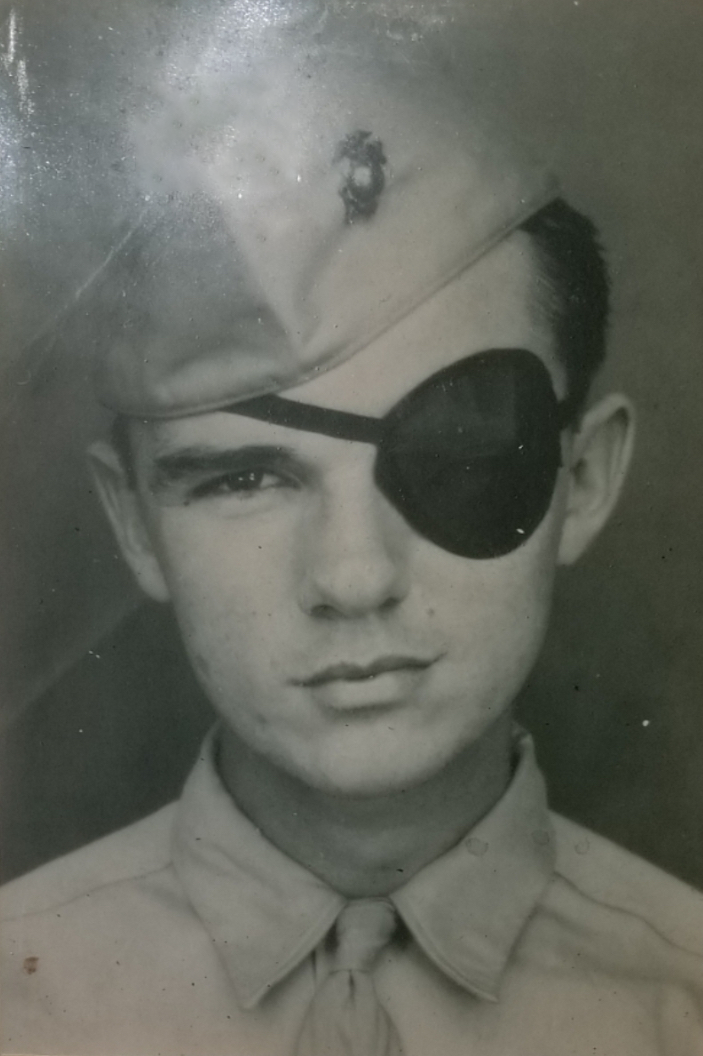
In the shadowed annals of American art, few figures embody the grit of the postwar everyman quite like John McRee Smith, better known by his enigmatic moniker Winocki. A Purple Heart veteran of World War II’s bloodiest theaters, Smith—born around 1930 in St. Louis—transformed the visceral scars of combat into luminous canvases that pulse with quiet defiance. As Winocki, he emerges not as a brooding Abstract Expressionist, but as a steadfast custodian of mid-century modernism, wielding oil paints like a Marine’s bayonet: precise, unyielding, and profoundly human.
Smith’s odyssey begins in the foxholes of the Palau Islands, where, in 1944, a Japanese artillery shard claimed his left eye during the hellish Peleliu campaign. Yet, amid the muck and mortar, he sketched his comrades’ haunted faces, capturing not glory, but the “aura of troops living in the field”—raw vignettes of camaraderie forged in terror. Discharged in 1945, he channeled this alchemy of loss into formal training at Washington University’s School of Fine Arts (1946–1948), followed by a fervent studio interlude until marriage in 1950 compelled him to the grind of MEICOM’s midnight printing shifts. Here, under bosses Harold Ford and Ray Lindewirth, Smith balanced fatherhood to ten children (a son and nine daughters) with nocturnal artistry, his one good eye a beacon in the dark.
His oeuvre, showcased on winocki.com, revels in still lifes that transcend domesticity. Oils like Hearts and Flowers (1954, $300 prize-winner at the St. Louis Artists Guild) bloom with audacious vibrancy: crimson petals unfurl against inky voids, petals veined like shrapnel wounds, flowers wilting yet defiant. Mid-century influences—Matisse’s Fauvist joy laced with Hopper’s lonely precision—infuse his forms with emotional geometry. Themes orbit resilience: vases teetering on edges evoke battlefield precariousness; fruits bruised but bursting symbolize life’s tenacious pulp. Smith’s technique, honed in leather-craft echoes from his artisan father, layers glazes with leather-tough opacity, building depth that rewards the gaze, much like a veteran’s guarded tales.
What elevates Winocki to uniqueness? He was no salon darling; his accolades—dozens of Guild honors since 1950—sprang from blue-collar anonymity, art as rebellion against rote labor. In an era of Jackson Pollock’s drips, Smith’s deliberate strokes affirm order amid chaos, a Purple Heart etched in pigment. His site, a digital reliquary, immortalizes this: sparse scans of oils that whisper, “Beauty endures the blind side.” Winocki doesn’t dazzle; he disarms, reminding us that true vision pierces from the periphery. He’s etched indelibly: the artist who painted through the dark, one unblinking eye at a time.